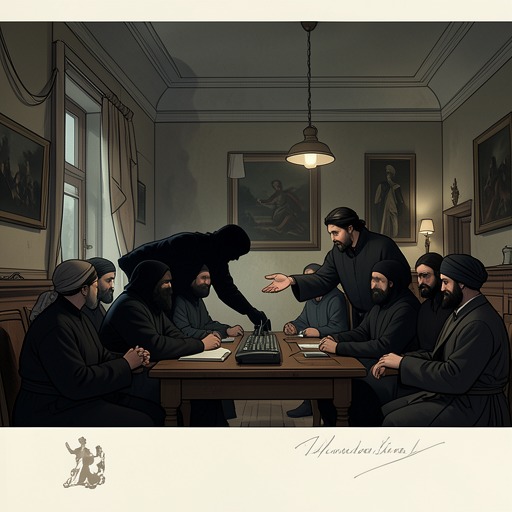
Inverted JHS inscription
The Pale Blue EyeThe Inverted JHS inscription is a scorched mark at the Icehouse that Edgar Allan Poe and Augustus Landor read as a reversed Christian inscription, transforming an obscure physical trace into a clue about the possible religious character of the crime against Leroy Fry. Its force lies both in what the letters suggest and in the fragile process by which the investigators recover and interpret them: a mark left behind after objects have been removed, then read as evidence of an invocation directed against Christ.
Appearance and Discovery
The inscription enters the investigation as a material remnant rather than a written message. In the Icehouse, Landor reasons that if a ceremony had taken place, its objects might have been carried away, but their impressions could have remained in the ground. The search is therefore directed toward absences: not the candles or stones themselves, but the marks their placement might have left. This approach makes the physical surface a kind of record, though one that has to be deliberately brought into view.
Poe notices that the traces do not fit what he expects, then calls Landor’s attention to scorch marks. He tears a page from Landor’s notebook, lays it over the grass, and sweeps a pencil across it until the shaded page registers the faint pattern. The resulting letters appear as SHJ. What had been nearly invisible becomes legible through a sequence of actions—recognition, transfer, and comparison—rather than by direct inspection alone. The clue is thus presented as both an object in the scene and the product of an investigative technique.
Decipherment and Interpretation
The first reading does not immediately solve the mark. SHJ prompts the pair to run through possible names and societies, but those guesses fail to produce a convincing fit. Poe then proposes reversing the individual letters and, if necessary, the whole message. Landor writes the letters out again in large strokes, making their reversed orientation easier to examine. Poe recognizes the result as Jesus Christ.
Landor observes that JHS is a familiar inscription from earlier times, though he has not encountered it written backward. Poe draws the consequential inference: if the familiar Christian sign has been reversed, the person who placed it may have been invoking someone directly opposed to Christ. The mark therefore carries two related meanings in the investigation. It recalls an established religious inscription, but its inversion recasts that sign as a possible act of opposition. This is an interpretation of the mark, not a confession or a direct account of what occurred; its significance depends on the investigators’ reasoning about orientation and intent.
Connection to the Suspected Rite
The decipherment follows Landor’s decision to consider religion as a starting premise for the inquiry into Leroy Fry’s heart being taken. He recalls that Fry had joined a disreputable group before turning to the Prayer Squad, and that Sylvanus Thayer had associated Fry’s body with religious fanaticism. Landor asks whether the crime might have left signs of ceremony and proposes that removed objects could still be traced through the impressions they made. The reversed inscription gives this line of inquiry a concrete sign, but it does not by itself establish who made it or prove the investigators’ entire theory.
A later view of the Marquis family’s private rite supplies a striking visual context for reading the clue. In the Icehouse, Landor sees tapers in rows of sconces, a circle of torches, and a triangle of candles within it; at the triangle’s base, letters have been etched. The scene’s deliberate arrangement of lights and shapes resembles the ceremonial setting that Landor and Poe had been seeking in the traces left by removed objects. The inscription’s placement among these ritual markings links the recovered letters to an enacted religious setting, even as the earlier decipherment remains an inference made from a damaged and reversed sign.
Evidence, Ritual, and Meaning
The investigation contrasts the visible order of the United States Military Academy with the concealed ceremony suspected at the Icehouse. During evening parade, the cadets move in formations, and the gap left by Leroy Fry is absorbed into the ranks so smoothly that a casual observer might not notice it. The ceremony Landor later witnesses is also organized around ordered bodies and prescribed objects, but its circle, triangle, flames, and etched letters belong to a private rite rather than the Academy’s public discipline. Against this contrast, the Inverted JHS inscription marks a competing religious order: a familiar sacred form altered into a possible sign of its opposite.
The clue’s evidentiary value remains inseparable from its method of recovery. The scorch marks must first be noticed; the page must be shaded; the letters must be read in reverse; and their apparent reference must then be interpreted. Each step narrows the possibilities, but none makes the mark speak independently of its interpreters. That progression suits an investigation built from fragments and traces, while also cautioning against treating one sign as proof of every suspicion. The inscription matters because it gives a physical basis to the theory of a rite, and because its reversal makes the investigators confront how a symbol’s meaning can change through the way it is read.